

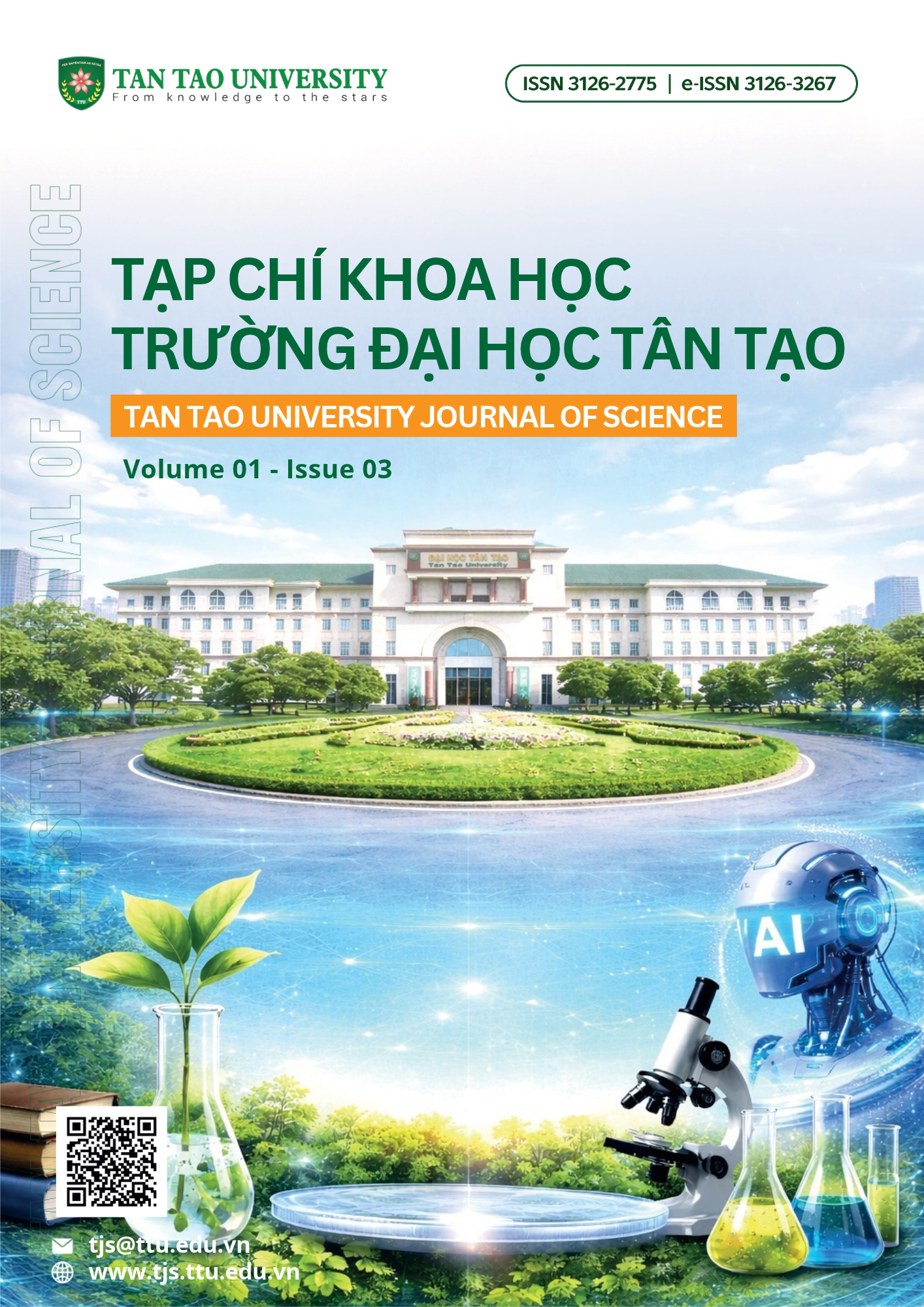
Tan Tao University Journal of Science (TJS) is a multidisciplinary academic journal established with the aim of disseminating scientific research (SR) results from Tan Tao University; introducing scientific studies both domestically and internationally to promote SR activities and technology transfer; and facilitating scientific and technological exchanges with relevant institutions to serve the socio-economic development of the Mekong Delta region and the country as a whole. The journal is divided into three main fields:
(I) Biomedical Sciences,
(II) Natural Science and Technology
(III) Social Sciences, Languages, and Economics.
TJS is periodically updated in accordance with legal regulations, serving as a platform to publish research findings, provide guidance, and exchange teaching and research experiences within the educational and academic fields of Tan Tao University.
Page 1-8
Purpose: Dyslipidemia remains a central causal and modifiable driver of atherosclerotic cardiovascular disease (ASCVD). The 2026 ACC/AHA/AACVPR/ABC/ACPM/ADA/AGS/APhA/ASPC/NLA/PCNA Guideline on the Management of Dyslipidemia represents the most consequential United States lipid management update since the 2018 cholesterol guideline. It restores explicit LDL-C and non-HDL-C treatment goals, expands lifetime lipid assessment, incorporates lipoprotein(a) and apolipoprotein B into risk personalization, and replaces the Pooled Cohort Equations with the American Heart Association PREVENT-ASCVD equations for primary prevention risk assessment. This clinical review summarizes the major changes in the 2026 dyslipidemia guideline and proposes a practical framework for clinical implementation.
Key Highlights: The guideline transitions lipid management from a threshold-based approach toward a more structured and individualized strategy. In adults aged 30 to 79 years without known ASCVD or subclinical atherosclerosis and LDL-C levels of 70 to 189 mg/dL, PREVENT-ASCVD is recommended for 10-year risk estimation, while 30-year risk assessment is emphasized in adults aged 30 to 59 years. Lipid-lowering therapy is recommended at lower estimated risk thresholds than in prior Pooled Cohort Equation-based strategies. Key updates include LDL-C goals of < 100 mg/dL for low, borderline, or intermediate-risk primary prevention patients and < 70 mg/dL for high-risk individuals. Secondary prevention targets include LDL-C < 55 mg/dL for very-high-risk ASCVD and < 70 mg/dL for ASCVD not classified as very high risk. Additional recommendations include universal adult lipoprotein(a) measurement at least once, selective apolipoprotein B assessment for residual risk evaluation, and earlier incorporation of evidence-based non-statin therapies when statins alone fail to achieve lipid goals.
Conclusion: The 2026 dyslipidemia guideline establishes a more aggressive, risk-based, and goal-directed prevention paradigm emphasizing earlier intervention, personalized risk assessment, and timely treatment intensification to reduce residual cardiovascular risk.
Page 9-21
Artificial intelligence (AI) has rapidly moved from a niche computational tool to an active participant in healthcare delivery and medical education. Its expanding role now extends beyond diagnosis to clinical trial screening platforms, decision support, physician-facing knowledge tools, and early pilots involving supervised prescription workflow. This review examines the evolution of healthcare AI, from traditional rule-based systems to machine learning, large language models, and multimodal AI, and explores its current applications across clinical practice, public health, and medical education. We discuss the major promises of AI, including improved diagnostic support, earlier disease detection, reduced administrative burden, scalable education, and augmented clinical reasoning. At the same time, we highlight important limitations and risks, including bias, hallucinations, limited generalizability, privacy concerns, automation bias, threats to humanistic care, and challenges to academic integrity. We further examine barriers to implementation, including technical integration, workflow disruption, regulatory uncertainty, and workforce preparedness. While AI offers substantial opportunities to improve healthcare systems and training environments, its impact will depend less on algorithmic capability alone and more on responsible integration, continuous oversight, and preservation of human judgment. Future efforts should prioritize trustworthy, equitable, and human-centered approaches that position AI as a tool to augment rather than replace clinician-patient relationship.
Page 22-39
Background: Atrial fibrillation is a worldwide burden to clinical healthcare, characterized by loss of normal sinus node pacemaker activity due to rapid electrical impulses from multiple atrial foci, resulting in ineffective atrial contraction and impaired blood pumping. Although no single etiology exists, atrial fibrillation is associated with cardiovascular risk factors such as hypertension and diabetes mellitus. atrial fibrillation increases the risk of stroke, myocardial infarction, heart failure and mortality. This review discusses the definition, classification, pathophysiology, diagnosis, and contemporary management strategies.
Main: Atrial fibrillation is commonly classified according European Society of Cardiology to its temporal pattern into first-diagnosed, paroxysmal, persistent, long-standing persistent, and permanent atrial fibrillation. The American Heart Association further recognizes its progression through stages ranging from at-risk and pre- atrial fibrillation states to permanent atrial fibrillation. The American Heart Association’s framework and European Society of Cardiology pathway share a unified principle of management: optimizing cardiovascular risk factors, preventing stroke, and controlling symptoms. Both emphasize integrated care, where comorbidity management and anticoagulation underpin therapy, while symptom control is tailored to individual patient needs.
Finding: Emerging evidence supports catheter ablation in newly diagnosed atrial fibrillation, including patients with mild heart failure, due to improved long-term cardiovascular outcomes and reduced hospitalizations. AP30663, a novel atrial-selective KCa2 inhibitor, has shown promising antiarrhythmic effects in preclinical studies and was conducted in phase II evaluation. Lifestyle and risk-factor modification, including weight reduction, exercise, smoking cessation, alcohol moderation, and control of hypertension and diabetes, are essential in slowing atrial fibrillation’s progression.
Conclusion: Contemporary management increasingly emphasizes early rhythm control, particularly catheter ablation, while novel agents such as AP30663 show promising potential. Long-term management also depends heavily on lifestyle and cardiovascular risk-factor modification.
Page 40-46
This study was conducted on ethanol extracts of Vitex negundo L. and Croton tonkinensis Gagnep. leaves which grown at the experimental farm of the Institute of Biotechnology, Tra Vinh University. The research objective was to evaluate the effect of sonication time on the content of flavonoids (TFC), phenolics (TPC), and antioxidant activities by DPPH method. The results showed that sonication time had a statistically significant effect on the content of TFC, TPC, and DPPH activity, and also showed clear differences between the two plant species. In Vitex negundo L., TFC (50 mgQE·g-1), TPC (36.15 mgGAE·g-1), and antioxidant activity (IC50 = 1.33 mg·mL-1) were highest at a sonication time of 5 minutes. Conversely, in Croton tonkinensis Gagnep, the TFC (25 mgQE·g-1) and TPC (20.13 mgGAE·g-1) content gradually increased with sonication time (15-30 minutes), then slightly decreased with increasing sonication time. The lowest antioxidant activity (IC50 = 1.57 mg·mL-1) was observed when the sonication time increased to 45 minutes. The study results show that polyphenol content and antioxidant activity depend on the stability and structural characteristics of the compounds under sonication. This research provides a scientific basis for optimizing the extraction process to improve the yield and biological activity of polyphenol compounds from plant sources.
Page 47-55
In this study, dry seeds of a brown cherry tomato variety were subjected to gamma irradiation at various doses (0, 30, 40, 50, and 70 Gy) to evaluate the effects of gamma radiation on the growth and development of the variety. The irradiated seeds were germinated for 10 days to assess the germination rate, seedling height, and to determine the median lethal dose (LD50). After 4 weeks of nursing, the seedlings were transplanted into a substrate consisting of soil, coconut coir, and organic fertilizer, followed by the recording of growth and developmental parameters. The results indicated that the 30 Gy dose was optimal for seed germination (over 70%) and seedling elongation (over 23 mm). The LD50 for this brown cherry tomato variety was determined to be 45.27 Gy. Although the 50 Gy dose showed superior stimulation in certain criteria, such as plant height (187 cm) and fruit Ca2+ content (over 73 ppm), the 30 Gy dose was overall considered to have the most favorable impact on the growth, development, and mineral nutrient content of this variety.
Page 56-63
Pepper (Capsicum spp.) is a high-value spice and vegetable crops used for commercial and industrial purpose. Pepper fruit is an excellent source of nutritional compounds. It is the main source of capsaicin, which varied strongly during fruit growth and maturation. The aim of the present study was to evaluate the effect of development stage of the fruit on capsaicin and pungency of ten pepper cultivars. Significant differences were observed among cultivars, with capsaicin content ranging from 38.55 mg·g-1 to 91,778.27 mg·g-1 and pungency values from 693.95 SHU to 1,652,008.91 SHU, indicating substantial variability in capsaicinoid accumulation. In all cultivars, capsaicin content and SHU increased progressively during early fruit development, reached peak levels at approximately 50 days after flowering, and declined slightly at the fully ripe stage. The highest pungency levels were recorded in Trinidad Moruga Scorpion (BC) and Bhut Jolokia (MG), confirming their classification as extremely pungent cultivars, whereas Biquinho pepper (TT) exhibited negligible capsaicin accumulation. Cluster analysis further classified the cultivars into distinct groups corresponding to their pungency levels, highlighting clear biochemical differentiation. The observed trends are associated with the regulation of capsaicinoid biosynthesis, particularly the activity of key enzymes involved in the phenylpropanoid and branched-chain fatty acid pathways. These findings demonstrate a strong correlation between capsaicin content and pungency and emphasize the combined influence of genetic factors and fruit developmental stage on capsaicinoid accumulation. The results provide valuable insights for optimizing harvest time and selecting suitable cultivars for targeted applications in food processing and bioactive compound production.
Page 64-70
Short-form video platforms have become a popular form of online interaction among young adult learners of English as a foreign language (EFL). Videos with built-in multi-modality make them effective tools in EFL learning. However, empirical studies of incorporation of these videos in the Vietnamese EFL setting remain limited. This study aims to investigate the impact of short-form videos on motivation of Vietnamese 10th grade students in learning English vocabulary. The research utilized a mixed-methods approach, involving pre-and post-4-week intervention with 120 students of the HUIT Center of High School Education in Ho Chi Minh City, and semi-structured interviews with 8 students. Results revealed a statistically higher student motivation after the intervention with selected English vocabulary videos of 20 to 60 seconds. Thematic analysis indicated that the videos positively influenced student engagement, interest, and confidence. These findings suggest that integrating short-form videos into EFL teaching enhance student engagement, and discuss implications for teachers to employ short-form videos in EFL contexts.
Page 71-77
This qualitative document analysis with descriptive quantitative mapping examines potential psychometric and pedagogical misalignments in Vietnam’s policy allowing the International English Language Testing System (IELTS) to substitute the official national high school graduation English exam for university admissions. By comparing the lexical, structural, and cognitive demands of the official 2025 Vietnamese National High School Graduation Examination (THPT), and an illustrative international benchmark (Cambridge IELTS 20), the study highlights areas where current score-conversion practices may under-represent the communicative construct intended by the national curriculum. The findings provide preliminary evidence that the THPT exam functions largely as a discrete-point achievement test, whereas IELTS requires integrative skills and a broader academic vocabulary. Drawing on construct validity, principles of assessment design, and the Assessment Use Argument, the paper posits that direct substitution policies overlook the distinct foundational objectives of each test and require stronger empirical concordance support.
Page 78-82
This study investigates students’ perceptions of oral corrective feedback (OCF) in English speaking classes at the secondary school level. The study examines students’ perceptions of OCF, their preferred feedback types, and the effects of feedback on speaking confidence. A quantitative descriptive design was used. Data were collected through a questionnaire with five-point Likert scale items from 25 Grade 7 and Grade 9 students in Tay Ninh province, Vietnam. The data were analyzed using descriptive statistics. The findings show that students generally have positive perceptions of oral corrective feedback. Most students believe that OCF helps improve speaking accuracy and awareness of errors. Students preferred supportive feedback types such as recasts, metalinguistic feedback, and elicitation. In addition, delayed feedback was more preferred than immediate correction because it made students feel more comfortable during speaking activities. The results also indicate that oral corrective feedback has both positive and negative effects on speaking confidence. While feedback increased students’ motivation and participation, some learners felt anxious when corrected publicly. Overall, the study suggests that teachers should provide feedback in a supportive and appropriate way to improve students’ speaking development and confidence.
Page 83-90
This study examines the impact of TikTok influencer credibility on Gen Z’s cosmetic purchase intention in Vietnam, with trust as a mediating variable and brand attachment as a moderating variable. Data were collected through a survey of Gen Z consumers and analyzed using the PLS-SEM method. The results indicate that the three dimensions of influencer credibility -attractiveness, trustworthiness, and expertise- positively influence trust, with attractiveness having the strongest effect. Trust significantly and directly affects purchase intention and mediates the relationship between influencer credibility and purchase intention. In addition, brand attachment has a moderating effect between trust and purchase intention. The findings provide practical implications for cosmetic brands in developing effective TikTok influencer marketing strategies targeting Gen Z.
Page 91-99
Higher education assessment, particularly within the social sciences and humanities, is currently confronting a crisis and profound challenges driven by the rapid evolution and proliferation of Generative Artificial Intelligence (GenAI). Traditional assessment frameworks have long operated under the assumption that a final written product serves as reliable evidence of a learner’s cognitive capacity and understanding. However, this foundational premise has been undermined by the ability of GenAI to generate comprehensive outputs within a remarkably short timeframe. Consequently, assessment practice has become trapped in a vicious cycle of prohibition, evasion, and detection. This paper argues that rather than focusing on the containment of AI, there is an imperative need to redesign assessments to accurately measure core competencies: academic thinking, selective agency, and accountability. To ensure the validity of evaluation, the paper proposes a paradigm shift from prioritizing written end-products to emphasizing the visible evidence of cognitive processes. On this basis, the paper introduces four assessment models adapted for the AI era, alongside a framework for academic integrity anchored in the transparent utilization of AI and student accountability.
Page 1-8
Purpose: Dyslipidemia remains a central causal and modifiable driver of atherosclerotic cardiovascular disease (ASCVD). The 2026 ACC/AHA/AACVPR/ABC/ACPM/ADA/AGS/APhA/ASPC/NLA/PCNA Guideline on the Management of Dyslipidemia represents the most consequential United States lipid management update since the 2018 cholesterol guideline. It restores explicit LDL-C and non-HDL-C treatment goals, expands lifetime lipid assessment, incorporates lipoprotein(a) and apolipoprotein B into risk personalization, and replaces the Pooled Cohort Equations with the American Heart Association PREVENT-ASCVD equations for primary prevention risk assessment. This clinical review summarizes the major changes in the 2026 dyslipidemia guideline and proposes a practical framework for clinical implementation.
Key Highlights: The guideline transitions lipid management from a threshold-based approach toward a more structured and individualized strategy. In adults aged 30 to 79 years without known ASCVD or subclinical atherosclerosis and LDL-C levels of 70 to 189 mg/dL, PREVENT-ASCVD is recommended for 10-year risk estimation, while 30-year risk assessment is emphasized in adults aged 30 to 59 years. Lipid-lowering therapy is recommended at lower estimated risk thresholds than in prior Pooled Cohort Equation-based strategies. Key updates include LDL-C goals of < 100 mg/dL for low, borderline, or intermediate-risk primary prevention patients and < 70 mg/dL for high-risk individuals. Secondary prevention targets include LDL-C < 55 mg/dL for very-high-risk ASCVD and < 70 mg/dL for ASCVD not classified as very high risk. Additional recommendations include universal adult lipoprotein(a) measurement at least once, selective apolipoprotein B assessment for residual risk evaluation, and earlier incorporation of evidence-based non-statin therapies when statins alone fail to achieve lipid goals.
Conclusion: The 2026 dyslipidemia guideline establishes a more aggressive, risk-based, and goal-directed prevention paradigm emphasizing earlier intervention, personalized risk assessment, and timely treatment intensification to reduce residual cardiovascular risk.
Page 9-21
Artificial intelligence (AI) has rapidly moved from a niche computational tool to an active participant in healthcare delivery and medical education. Its expanding role now extends beyond diagnosis to clinical trial screening platforms, decision support, physician-facing knowledge tools, and early pilots involving supervised prescription workflow. This review examines the evolution of healthcare AI, from traditional rule-based systems to machine learning, large language models, and multimodal AI, and explores its current applications across clinical practice, public health, and medical education. We discuss the major promises of AI, including improved diagnostic support, earlier disease detection, reduced administrative burden, scalable education, and augmented clinical reasoning. At the same time, we highlight important limitations and risks, including bias, hallucinations, limited generalizability, privacy concerns, automation bias, threats to humanistic care, and challenges to academic integrity. We further examine barriers to implementation, including technical integration, workflow disruption, regulatory uncertainty, and workforce preparedness. While AI offers substantial opportunities to improve healthcare systems and training environments, its impact will depend less on algorithmic capability alone and more on responsible integration, continuous oversight, and preservation of human judgment. Future efforts should prioritize trustworthy, equitable, and human-centered approaches that position AI as a tool to augment rather than replace clinician-patient relationship.
Page 22-39
Background: Atrial fibrillation is a worldwide burden to clinical healthcare, characterized by loss of normal sinus node pacemaker activity due to rapid electrical impulses from multiple atrial foci, resulting in ineffective atrial contraction and impaired blood pumping. Although no single etiology exists, atrial fibrillation is associated with cardiovascular risk factors such as hypertension and diabetes mellitus. atrial fibrillation increases the risk of stroke, myocardial infarction, heart failure and mortality. This review discusses the definition, classification, pathophysiology, diagnosis, and contemporary management strategies.
Main: Atrial fibrillation is commonly classified according European Society of Cardiology to its temporal pattern into first-diagnosed, paroxysmal, persistent, long-standing persistent, and permanent atrial fibrillation. The American Heart Association further recognizes its progression through stages ranging from at-risk and pre- atrial fibrillation states to permanent atrial fibrillation. The American Heart Association’s framework and European Society of Cardiology pathway share a unified principle of management: optimizing cardiovascular risk factors, preventing stroke, and controlling symptoms. Both emphasize integrated care, where comorbidity management and anticoagulation underpin therapy, while symptom control is tailored to individual patient needs.
Finding: Emerging evidence supports catheter ablation in newly diagnosed atrial fibrillation, including patients with mild heart failure, due to improved long-term cardiovascular outcomes and reduced hospitalizations. AP30663, a novel atrial-selective KCa2 inhibitor, has shown promising antiarrhythmic effects in preclinical studies and was conducted in phase II evaluation. Lifestyle and risk-factor modification, including weight reduction, exercise, smoking cessation, alcohol moderation, and control of hypertension and diabetes, are essential in slowing atrial fibrillation’s progression.
Conclusion: Contemporary management increasingly emphasizes early rhythm control, particularly catheter ablation, while novel agents such as AP30663 show promising potential. Long-term management also depends heavily on lifestyle and cardiovascular risk-factor modification.
Page 40-46
This study was conducted on ethanol extracts of Vitex negundo L. and Croton tonkinensis Gagnep. leaves which grown at the experimental farm of the Institute of Biotechnology, Tra Vinh University. The research objective was to evaluate the effect of sonication time on the content of flavonoids (TFC), phenolics (TPC), and antioxidant activities by DPPH method. The results showed that sonication time had a statistically significant effect on the content of TFC, TPC, and DPPH activity, and also showed clear differences between the two plant species. In Vitex negundo L., TFC (50 mgQE·g-1), TPC (36.15 mgGAE·g-1), and antioxidant activity (IC50 = 1.33 mg·mL-1) were highest at a sonication time of 5 minutes. Conversely, in Croton tonkinensis Gagnep, the TFC (25 mgQE·g-1) and TPC (20.13 mgGAE·g-1) content gradually increased with sonication time (15-30 minutes), then slightly decreased with increasing sonication time. The lowest antioxidant activity (IC50 = 1.57 mg·mL-1) was observed when the sonication time increased to 45 minutes. The study results show that polyphenol content and antioxidant activity depend on the stability and structural characteristics of the compounds under sonication. This research provides a scientific basis for optimizing the extraction process to improve the yield and biological activity of polyphenol compounds from plant sources.
Page 47-55
In this study, dry seeds of a brown cherry tomato variety were subjected to gamma irradiation at various doses (0, 30, 40, 50, and 70 Gy) to evaluate the effects of gamma radiation on the growth and development of the variety. The irradiated seeds were germinated for 10 days to assess the germination rate, seedling height, and to determine the median lethal dose (LD50). After 4 weeks of nursing, the seedlings were transplanted into a substrate consisting of soil, coconut coir, and organic fertilizer, followed by the recording of growth and developmental parameters. The results indicated that the 30 Gy dose was optimal for seed germination (over 70%) and seedling elongation (over 23 mm). The LD50 for this brown cherry tomato variety was determined to be 45.27 Gy. Although the 50 Gy dose showed superior stimulation in certain criteria, such as plant height (187 cm) and fruit Ca2+ content (over 73 ppm), the 30 Gy dose was overall considered to have the most favorable impact on the growth, development, and mineral nutrient content of this variety.
Page 56-63
Pepper (Capsicum spp.) is a high-value spice and vegetable crops used for commercial and industrial purpose. Pepper fruit is an excellent source of nutritional compounds. It is the main source of capsaicin, which varied strongly during fruit growth and maturation. The aim of the present study was to evaluate the effect of development stage of the fruit on capsaicin and pungency of ten pepper cultivars. Significant differences were observed among cultivars, with capsaicin content ranging from 38.55 mg·g-1 to 91,778.27 mg·g-1 and pungency values from 693.95 SHU to 1,652,008.91 SHU, indicating substantial variability in capsaicinoid accumulation. In all cultivars, capsaicin content and SHU increased progressively during early fruit development, reached peak levels at approximately 50 days after flowering, and declined slightly at the fully ripe stage. The highest pungency levels were recorded in Trinidad Moruga Scorpion (BC) and Bhut Jolokia (MG), confirming their classification as extremely pungent cultivars, whereas Biquinho pepper (TT) exhibited negligible capsaicin accumulation. Cluster analysis further classified the cultivars into distinct groups corresponding to their pungency levels, highlighting clear biochemical differentiation. The observed trends are associated with the regulation of capsaicinoid biosynthesis, particularly the activity of key enzymes involved in the phenylpropanoid and branched-chain fatty acid pathways. These findings demonstrate a strong correlation between capsaicin content and pungency and emphasize the combined influence of genetic factors and fruit developmental stage on capsaicinoid accumulation. The results provide valuable insights for optimizing harvest time and selecting suitable cultivars for targeted applications in food processing and bioactive compound production.
Page 64-70
Short-form video platforms have become a popular form of online interaction among young adult learners of English as a foreign language (EFL). Videos with built-in multi-modality make them effective tools in EFL learning. However, empirical studies of incorporation of these videos in the Vietnamese EFL setting remain limited. This study aims to investigate the impact of short-form videos on motivation of Vietnamese 10th grade students in learning English vocabulary. The research utilized a mixed-methods approach, involving pre-and post-4-week intervention with 120 students of the HUIT Center of High School Education in Ho Chi Minh City, and semi-structured interviews with 8 students. Results revealed a statistically higher student motivation after the intervention with selected English vocabulary videos of 20 to 60 seconds. Thematic analysis indicated that the videos positively influenced student engagement, interest, and confidence. These findings suggest that integrating short-form videos into EFL teaching enhance student engagement, and discuss implications for teachers to employ short-form videos in EFL contexts.
Page 71-77
This qualitative document analysis with descriptive quantitative mapping examines potential psychometric and pedagogical misalignments in Vietnam’s policy allowing the International English Language Testing System (IELTS) to substitute the official national high school graduation English exam for university admissions. By comparing the lexical, structural, and cognitive demands of the official 2025 Vietnamese National High School Graduation Examination (THPT), and an illustrative international benchmark (Cambridge IELTS 20), the study highlights areas where current score-conversion practices may under-represent the communicative construct intended by the national curriculum. The findings provide preliminary evidence that the THPT exam functions largely as a discrete-point achievement test, whereas IELTS requires integrative skills and a broader academic vocabulary. Drawing on construct validity, principles of assessment design, and the Assessment Use Argument, the paper posits that direct substitution policies overlook the distinct foundational objectives of each test and require stronger empirical concordance support.
Page 78-82
This study investigates students’ perceptions of oral corrective feedback (OCF) in English speaking classes at the secondary school level. The study examines students’ perceptions of OCF, their preferred feedback types, and the effects of feedback on speaking confidence. A quantitative descriptive design was used. Data were collected through a questionnaire with five-point Likert scale items from 25 Grade 7 and Grade 9 students in Tay Ninh province, Vietnam. The data were analyzed using descriptive statistics. The findings show that students generally have positive perceptions of oral corrective feedback. Most students believe that OCF helps improve speaking accuracy and awareness of errors. Students preferred supportive feedback types such as recasts, metalinguistic feedback, and elicitation. In addition, delayed feedback was more preferred than immediate correction because it made students feel more comfortable during speaking activities. The results also indicate that oral corrective feedback has both positive and negative effects on speaking confidence. While feedback increased students’ motivation and participation, some learners felt anxious when corrected publicly. Overall, the study suggests that teachers should provide feedback in a supportive and appropriate way to improve students’ speaking development and confidence.
Page 83-90
This study examines the impact of TikTok influencer credibility on Gen Z’s cosmetic purchase intention in Vietnam, with trust as a mediating variable and brand attachment as a moderating variable. Data were collected through a survey of Gen Z consumers and analyzed using the PLS-SEM method. The results indicate that the three dimensions of influencer credibility -attractiveness, trustworthiness, and expertise- positively influence trust, with attractiveness having the strongest effect. Trust significantly and directly affects purchase intention and mediates the relationship between influencer credibility and purchase intention. In addition, brand attachment has a moderating effect between trust and purchase intention. The findings provide practical implications for cosmetic brands in developing effective TikTok influencer marketing strategies targeting Gen Z.
Page 91-99
Higher education assessment, particularly within the social sciences and humanities, is currently confronting a crisis and profound challenges driven by the rapid evolution and proliferation of Generative Artificial Intelligence (GenAI). Traditional assessment frameworks have long operated under the assumption that a final written product serves as reliable evidence of a learner’s cognitive capacity and understanding. However, this foundational premise has been undermined by the ability of GenAI to generate comprehensive outputs within a remarkably short timeframe. Consequently, assessment practice has become trapped in a vicious cycle of prohibition, evasion, and detection. This paper argues that rather than focusing on the containment of AI, there is an imperative need to redesign assessments to accurately measure core competencies: academic thinking, selective agency, and accountability. To ensure the validity of evaluation, the paper proposes a paradigm shift from prioritizing written end-products to emphasizing the visible evidence of cognitive processes. On this basis, the paper introduces four assessment models adapted for the AI era, alongside a framework for academic integrity anchored in the transparent utilization of AI and student accountability.