

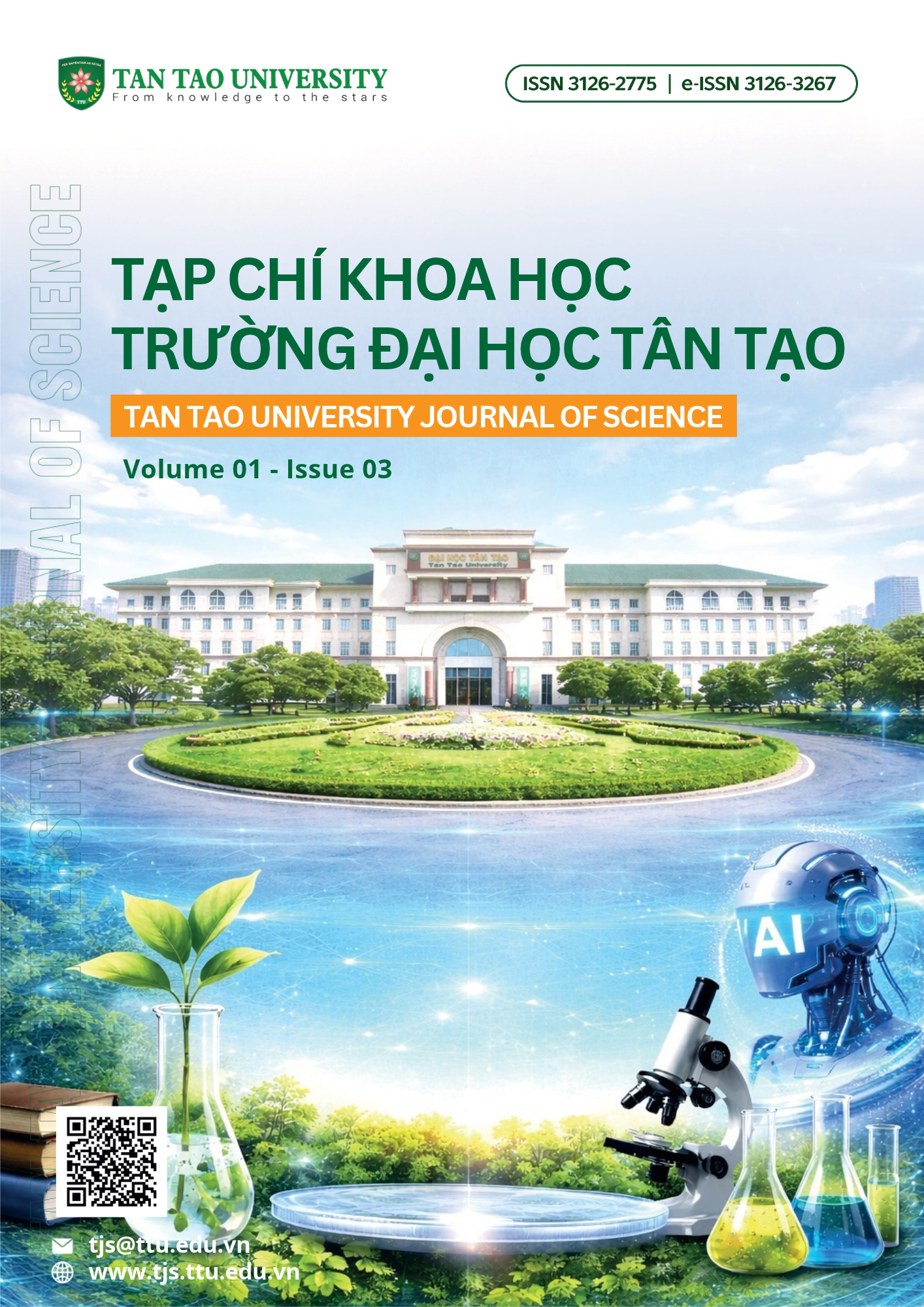
Tạp chí Khoa học Trường Đại học Tân Tạo (TJS) là tạp chí đa ngành với mục tiêu thông tin về các kết quả nghiên cứu khoa học (NCKH) của Trường Đại học Tân Tạo; giới thiệu các NCKH trong và ngoài nước nhằm góp phần đẩy mạnh công tác NCKH và chuyển giao công nghệ; trao đổi thông tin khoa học công nghệ với các đơn vị liên quan để phục vụ cho sự phát triển kinh tế - xã hội vùng Đồng bằng sông Cửu Long và cả nước. Tạp chí được chia thành 3 nhóm lĩnh vực gồm:
(I) Khoa học y sinh,
(II) Khoa học tự nhiên và kỹ thuật
(III) Khoa học xã hội, ngôn ngữ và kinh tế.
Định kỳ cập nhật thông tin theo quy định pháp luật, để giới thiệu, công bố các kết quả NCKH, hướng dẫn, trao đổi kinh nghiệm giảng dạy, nghiên cứu thuộc lĩnh vực đào tạo, giảng dạy của Trường Đại học Tân Tạo.
Page 1-8
Purpose: Dyslipidemia remains a central causal and modifiable driver of atherosclerotic cardiovascular disease (ASCVD). The 2026 ACC/AHA/AACVPR/ABC/ACPM/ADA/AGS/APhA/ASPC/NLA/PCNA Guideline on the Management of Dyslipidemia represents the most consequential United States lipid management update since the 2018 cholesterol guideline. It restores explicit LDL-C and non-HDL-C treatment goals, expands lifetime lipid assessment, incorporates lipoprotein(a) and apolipoprotein B into risk personalization, and replaces the Pooled Cohort Equations with the American Heart Association PREVENT-ASCVD equations for primary prevention risk assessment. This clinical review summarizes the major changes in the 2026 dyslipidemia guideline and proposes a practical framework for clinical implementation.
Key Highlights: The guideline transitions lipid management from a threshold-based approach toward a more structured and individualized strategy. In adults aged 30 to 79 years without known ASCVD or subclinical atherosclerosis and LDL-C levels of 70 to 189 mg/dL, PREVENT-ASCVD is recommended for 10-year risk estimation, while 30-year risk assessment is emphasized in adults aged 30 to 59 years. Lipid-lowering therapy is recommended at lower estimated risk thresholds than in prior Pooled Cohort Equation-based strategies. Key updates include LDL-C goals of < 100 mg/dL for low, borderline, or intermediate-risk primary prevention patients and < 70 mg/dL for high-risk individuals. Secondary prevention targets include LDL-C < 55 mg/dL for very-high-risk ASCVD and < 70 mg/dL for ASCVD not classified as very high risk. Additional recommendations include universal adult lipoprotein(a) measurement at least once, selective apolipoprotein B assessment for residual risk evaluation, and earlier incorporation of evidence-based non-statin therapies when statins alone fail to achieve lipid goals.
Conclusion: The 2026 dyslipidemia guideline establishes a more aggressive, risk-based, and goal-directed prevention paradigm emphasizing earlier intervention, personalized risk assessment, and timely treatment intensification to reduce residual cardiovascular risk.
Page 9-21
Artificial intelligence (AI) has rapidly moved from a niche computational tool to an active participant in healthcare delivery and medical education. Its expanding role now extends beyond diagnosis to clinical trial screening platforms, decision support, physician-facing knowledge tools, and early pilots involving supervised prescription workflow. This review examines the evolution of healthcare AI, from traditional rule-based systems to machine learning, large language models, and multimodal AI, and explores its current applications across clinical practice, public health, and medical education. We discuss the major promises of AI, including improved diagnostic support, earlier disease detection, reduced administrative burden, scalable education, and augmented clinical reasoning. At the same time, we highlight important limitations and risks, including bias, hallucinations, limited generalizability, privacy concerns, automation bias, threats to humanistic care, and challenges to academic integrity. We further examine barriers to implementation, including technical integration, workflow disruption, regulatory uncertainty, and workforce preparedness. While AI offers substantial opportunities to improve healthcare systems and training environments, its impact will depend less on algorithmic capability alone and more on responsible integration, continuous oversight, and preservation of human judgment. Future efforts should prioritize trustworthy, equitable, and human-centered approaches that position AI as a tool to augment rather than replace clinician-patient relationship.
Page 22-39
Background: Atrial fibrillation is a worldwide burden to clinical healthcare, characterized by loss of normal sinus node pacemaker activity due to rapid electrical impulses from multiple atrial foci, resulting in ineffective atrial contraction and impaired blood pumping. Although no single etiology exists, atrial fibrillation is associated with cardiovascular risk factors such as hypertension and diabetes mellitus. atrial fibrillation increases the risk of stroke, myocardial infarction, heart failure and mortality. This review discusses the definition, classification, pathophysiology, diagnosis, and contemporary management strategies.
Main: Atrial fibrillation is commonly classified according European Society of Cardiology to its temporal pattern into first-diagnosed, paroxysmal, persistent, long-standing persistent, and permanent atrial fibrillation. The American Heart Association further recognizes its progression through stages ranging from at-risk and pre- atrial fibrillation states to permanent atrial fibrillation. The American Heart Association’s framework and European Society of Cardiology pathway share a unified principle of management: optimizing cardiovascular risk factors, preventing stroke, and controlling symptoms. Both emphasize integrated care, where comorbidity management and anticoagulation underpin therapy, while symptom control is tailored to individual patient needs.
Finding: Emerging evidence supports catheter ablation in newly diagnosed atrial fibrillation, including patients with mild heart failure, due to improved long-term cardiovascular outcomes and reduced hospitalizations. AP30663, a novel atrial-selective KCa2 inhibitor, has shown promising antiarrhythmic effects in preclinical studies and was conducted in phase II evaluation. Lifestyle and risk-factor modification, including weight reduction, exercise, smoking cessation, alcohol moderation, and control of hypertension and diabetes, are essential in slowing atrial fibrillation’s progression.
Conclusion: Contemporary management increasingly emphasizes early rhythm control, particularly catheter ablation, while novel agents such as AP30663 show promising potential. Long-term management also depends heavily on lifestyle and cardiovascular risk-factor modification.
Page 40-46
Nghiên cứu được thực hiện trên cao chiết ethanol của lá cây Ngũ trảo (Vitex negundo L.) và cây Khổ sâm (Croton tonkinensis Gagnep.) được trồng tại trại thực nghiệm, Viện Công nghệ Sinh học, Đại học Trà Vinh. Mục tiêu nghiên cứu là đánh giá ảnh hưởng của thời gian siêu âm lên hàm lượng flavonoid (TFC), phenolic (TPC) và đặc tính kháng oxy hóa thông qua đánh giá chỉ số IC50 (phương pháp DPPH). Kết quả nghiên cứu cho thấy thời gian siêu âm ảnh hưởng có ý nghĩa thống kê đến hàm lượng TFC, TPC và hoạt tính DPPH, đồng thời thể hiện sự khác biệt rõ rệt giữa 2 loài thực vật. Ở cây Ngũ trảo, TFC (50 mgQE.g-1), TPC (36,15 mgGAE.g-1) và hoạt tính kháng oxy (IC50 = 1,33 mg.mL-1) cao nhất tại thời gian siêu âm 5 phút. Ngược lại, cây Khổ sâm, hàm lượng TFC (25 mgQE.g-1) và TPC (20,13 mgGAE.g-1) tăng dần theo thời gian siêu âm (15- 30 phút), sau đó giảm nhẹ khi tiếp tục gia tăng thời gian. Hoạt tính kháng oxy thấp nhất (IC50 = 1,57 mg.mL-1) khi gia tăng thời gian lên 45 phút. Kết quả nghiên cứu cho thấy hàm lượng polyphenol và hoạt tính kháng oxy hóa phụ thuộc vào độ bền và đặc điểm cấu trúc của các hợp chất dưới tác động của sóng siêu âm. Nghiên cứu này cung cấp cơ sở khoa học cho việc tối ưu hóa quy trình chiết xuất nhằm nâng cao hiệu suất thu nhận và hoạt tính sinh học của các hợp chất polyphenol từ nguồn nguyên liệu thực vật.
Page 47-55
Trong nghiên cứu này, chúng tôi tiến hành xử lý chiếu xạ hạt khô của giống cà chua bi nâu ở các liều chiếu xạ khác nhau (0, 30, 40, 50, 70 Gy) nhằm đánh giá ảnh hưởng của liều chiếu xạ tia gamma lên khả năng sinh trưởng và phát triển của giống sau chiếu xạ. Hạt giống sau chiếu xạ được cho nảy mầm trong 10 ngày để đánh giá tỷ lệ nảy mầm, chiều cao thân mầm và xác định liều gây chết 50%. Cây con sau đó được ươm 4 tuần và được trồng trên giá thể gồm đất, xơ dừa và phân hữu cơ, sau đó tiến hành ghi nhận các chỉ tiêu về sinh trưởng và phát triển. Kết quả đánh giá cho thấy liều chiếu xạ 30 Gy là tốt nhất cho tỷ lệ nảy mầm của hạt (trên 70%) và sự phát triển của thân mầm (dài trên 23 mm). Liều gây chết ở 50% (LD50) của giống cà chua bi nâu được xác định là 45,27 Gy. Mặc dù ở một số chỉ tiêu, liều chiếu xạ 50 Gy cho thấy sự kích thích tốt hơn như chiều cao cây (187 cm) và hàm lượng Ca2+ trong quả (trên 73 ppm), nhưng nhìn chung liều chiếu xạ 30 Gy được xem là có ảnh hưởng tốt nhất đến sự sinh trưởng và phát triển, cũng như hàm lượng dinh dưỡng khoáng của giống cà chua bi nâu.
Page 56-63
Ớt (Capsicum spp.) là một loại gia vị và rau củ có giá trị cao, được sử dụng cho mục đích thương mại và công nghiệp. Quả ớt là một nguồn nguyên liệu giàu dinh dưỡng. Bên trong quả ớt có chứa hàm lượng capsaicin khác nhau ở các giai đoạn chín của quả. Mục tiêu nghiên cứu đánh giá ảnh hưởng của giai đoạn chín của quả lên hàm lượng capsaicin và độ cay của mười giống ớt. Kết quả cho thấy hàm lượng capsaicin dao động từ 38,55 đến 91.778,27 mg·g-1 và giá trị độ cay từ 693,95 SHU đến 1.652.008,91 SHU, phản ánh sự khác biệt lớn giữa các giống. Hàm lượng capsaicin và độ cay có xu hướng tăng dần từ giai đoạn đầu đến giai đoạn quả trưởng thành và đạt cực đại ở khoảng 50 NSTP, sau đó giảm nhẹ ở giai đoạn chín hoàn toàn (60 NSTP). Các giống ớt siêu cay như Trinidad Moruga Scorpion (BC) và Bhut Jolokia (MG) thể hiện khả năng tích lũy capsaicin và độ cay vượt trội, trong khi giống Biquinho pepper (TT) gần như không tích lũy hợp chất này. Kết quả nghiên cứu khẳng định mối quan hệ chặt chẽ giữa hàm lượng capsaicin và độ cay, đồng thời nhấn mạnh vai trò của yếu tố di truyền và giai đoạn phát triển quả trong quá trình tích lũy capsaicinoid. Những phát hiện này có ý nghĩa quan trọng trong việc xác định thời điểm thu hoạch tối ưu và định hướng sử dụng giống phù hợp trong sản xuất và chế biến ớt.
Page 64-70
Short-form video platforms have become a popular form of online interaction among young adult learners of English as a foreign language (EFL). Videos with built-in multi-modality make them effective tools in EFL learning. However, empirical studies of incorporation of these videos in the Vietnamese EFL setting remain limited. This study aims to investigate the impact of short-form videos on motivation of Vietnamese 10th grade students in learning English vocabulary. The research utilized a mixed-methods approach, involving pre-and post-4-week intervention with 120 students of the HUIT Center of High School Education in Ho Chi Minh City, and semi-structured interviews with 8 students. Results revealed a statistically higher student motivation after the intervention with selected English vocabulary videos of 20 to 60 seconds. Thematic analysis indicated that the videos positively influenced student engagement, interest, and confidence. These findings suggest that integrating short-form videos into EFL teaching enhance student engagement, and discuss implications for teachers to employ short-form videos in EFL contexts.
Page 71-77
This qualitative document analysis with descriptive quantitative mapping examines potential psychometric and pedagogical misalignments in Vietnam’s policy allowing the International English Language Testing System (IELTS) to substitute the official national high school graduation English exam for university admissions. By comparing the lexical, structural, and cognitive demands of the official 2025 Vietnamese National High School Graduation Examination (THPT), and an illustrative international benchmark (Cambridge IELTS 20), the study highlights areas where current score-conversion practices may under-represent the communicative construct intended by the national curriculum. The findings provide preliminary evidence that the THPT exam functions largely as a discrete-point achievement test, whereas IELTS requires integrative skills and a broader academic vocabulary. Drawing on construct validity, principles of assessment design, and the Assessment Use Argument, the paper posits that direct substitution policies overlook the distinct foundational objectives of each test and require stronger empirical concordance support.
Page 78-82
This study investigates students’ perceptions of oral corrective feedback (OCF) in English speaking classes at the secondary school level. The study examines students’ perceptions of OCF, their preferred feedback types, and the effects of feedback on speaking confidence. A quantitative descriptive design was used. Data were collected through a questionnaire with five-point Likert scale items from 25 Grade 7 and Grade 9 students in Tay Ninh province, Vietnam. The data were analyzed using descriptive statistics. The findings show that students generally have positive perceptions of oral corrective feedback. Most students believe that OCF helps improve speaking accuracy and awareness of errors. Students preferred supportive feedback types such as recasts, metalinguistic feedback, and elicitation. In addition, delayed feedback was more preferred than immediate correction because it made students feel more comfortable during speaking activities. The results also indicate that oral corrective feedback has both positive and negative effects on speaking confidence. While feedback increased students’ motivation and participation, some learners felt anxious when corrected publicly. Overall, the study suggests that teachers should provide feedback in a supportive and appropriate way to improve students’ speaking development and confidence.
Page 83-90
Nghiên cứu này phân tích tác động của độ tin cậy của người ảnh hưởng trên TikTok đến ý định mua mỹ phẩm của Gen Z tại Việt Nam, đồng thời xem xét vai trò trung gian của niềm tin và vai trò điều tiết của sự gắn bó thương hiệu. Dữ liệu được thu thập từ khảo sát Gen Z và phân tích bằng phương pháp PLS-SEM. Kết quả cho thấy ba thành phần của độ tin cậy người ảnh hưởng gồm sự hấp dẫn, mức độ đáng tin và chuyên môn đều tác động tích cực đến niềm tin, trong đó sự hấp dẫn có ảnh hưởng mạnh nhất. Niềm tin có tác động trực tiếp đáng kể đến ý định mua và đóng vai trò trung gian trong mối quan hệ giữa các đặc điểm của người ảnh hưởng và ý định mua. Bên cạnh đó, sự gắn bó thương hiệu có vai trò điều tiết tích cực mối quan hệ giữa niềm tin và ý định mua. Nghiên cứu cung cấp hàm ý quan trọng cho doanh nghiệp mỹ phẩm khi triển khai tiếp thị người ảnh hưởng trên TikTok hướng đến Gen Z.
Page 91-99
Đánh giá giáo dục đại học, đặc biệt ở các môn khoa học xã hội và nhân văn, đang đối mặt với một sự khủng hoảng, thách thức khi các công cụ AI tạo sinh (GenAI) đang ngày càng phát triển và phổ biến. Bởi lẽ, việc đánh giá cũ dựa trên một giả định rằng sản phẩm văn bản nộp cuối kỳ là bằng chứng đáng tin cậy cho năng lực tư duy và hiểu biết của người học. Tuy nhiên, giả định nền tảng này bị suy yếu khi GenAI có tạo thể tạo ra sản phẩm hoàn chỉnh trong một thời gian ngắn. Từ đó, việc đánh giá rơi vào vòng luẩn quẩn: cấm đoán, đối phó và truy vết. Bài viết lập luận rằng thay vì tập trung ngăn chặn AI, cần tái thiết kế đánh giá để đo đúng năng lực cốt lõi: tư duy học thuật, năng lực lựa chọn và trách nhiệm giải trình. Để đảm bảo tính hợp lệ của việc đánh giá, bài viết đề xuất chuyển hệ mục tiêu từ nhấn mạnh vào sản phẩm văn bản đầu ra sang minh chứng tư duy. Trên cơ sở đó, bài viết đề xuất bốn mô hình đánh giá phù hợp thời AI và quy tắc liêm chính học thuật dựa trên minh bạch sử dụng AI cùng quy trách nhiệm cho người học.
Page 1-8
Purpose: Dyslipidemia remains a central causal and modifiable driver of atherosclerotic cardiovascular disease (ASCVD). The 2026 ACC/AHA/AACVPR/ABC/ACPM/ADA/AGS/APhA/ASPC/NLA/PCNA Guideline on the Management of Dyslipidemia represents the most consequential United States lipid management update since the 2018 cholesterol guideline. It restores explicit LDL-C and non-HDL-C treatment goals, expands lifetime lipid assessment, incorporates lipoprotein(a) and apolipoprotein B into risk personalization, and replaces the Pooled Cohort Equations with the American Heart Association PREVENT-ASCVD equations for primary prevention risk assessment. This clinical review summarizes the major changes in the 2026 dyslipidemia guideline and proposes a practical framework for clinical implementation.
Key Highlights: The guideline transitions lipid management from a threshold-based approach toward a more structured and individualized strategy. In adults aged 30 to 79 years without known ASCVD or subclinical atherosclerosis and LDL-C levels of 70 to 189 mg/dL, PREVENT-ASCVD is recommended for 10-year risk estimation, while 30-year risk assessment is emphasized in adults aged 30 to 59 years. Lipid-lowering therapy is recommended at lower estimated risk thresholds than in prior Pooled Cohort Equation-based strategies. Key updates include LDL-C goals of < 100 mg/dL for low, borderline, or intermediate-risk primary prevention patients and < 70 mg/dL for high-risk individuals. Secondary prevention targets include LDL-C < 55 mg/dL for very-high-risk ASCVD and < 70 mg/dL for ASCVD not classified as very high risk. Additional recommendations include universal adult lipoprotein(a) measurement at least once, selective apolipoprotein B assessment for residual risk evaluation, and earlier incorporation of evidence-based non-statin therapies when statins alone fail to achieve lipid goals.
Conclusion: The 2026 dyslipidemia guideline establishes a more aggressive, risk-based, and goal-directed prevention paradigm emphasizing earlier intervention, personalized risk assessment, and timely treatment intensification to reduce residual cardiovascular risk.
Page 9-21
Artificial intelligence (AI) has rapidly moved from a niche computational tool to an active participant in healthcare delivery and medical education. Its expanding role now extends beyond diagnosis to clinical trial screening platforms, decision support, physician-facing knowledge tools, and early pilots involving supervised prescription workflow. This review examines the evolution of healthcare AI, from traditional rule-based systems to machine learning, large language models, and multimodal AI, and explores its current applications across clinical practice, public health, and medical education. We discuss the major promises of AI, including improved diagnostic support, earlier disease detection, reduced administrative burden, scalable education, and augmented clinical reasoning. At the same time, we highlight important limitations and risks, including bias, hallucinations, limited generalizability, privacy concerns, automation bias, threats to humanistic care, and challenges to academic integrity. We further examine barriers to implementation, including technical integration, workflow disruption, regulatory uncertainty, and workforce preparedness. While AI offers substantial opportunities to improve healthcare systems and training environments, its impact will depend less on algorithmic capability alone and more on responsible integration, continuous oversight, and preservation of human judgment. Future efforts should prioritize trustworthy, equitable, and human-centered approaches that position AI as a tool to augment rather than replace clinician-patient relationship.
Page 22-39
Background: Atrial fibrillation is a worldwide burden to clinical healthcare, characterized by loss of normal sinus node pacemaker activity due to rapid electrical impulses from multiple atrial foci, resulting in ineffective atrial contraction and impaired blood pumping. Although no single etiology exists, atrial fibrillation is associated with cardiovascular risk factors such as hypertension and diabetes mellitus. atrial fibrillation increases the risk of stroke, myocardial infarction, heart failure and mortality. This review discusses the definition, classification, pathophysiology, diagnosis, and contemporary management strategies.
Main: Atrial fibrillation is commonly classified according European Society of Cardiology to its temporal pattern into first-diagnosed, paroxysmal, persistent, long-standing persistent, and permanent atrial fibrillation. The American Heart Association further recognizes its progression through stages ranging from at-risk and pre- atrial fibrillation states to permanent atrial fibrillation. The American Heart Association’s framework and European Society of Cardiology pathway share a unified principle of management: optimizing cardiovascular risk factors, preventing stroke, and controlling symptoms. Both emphasize integrated care, where comorbidity management and anticoagulation underpin therapy, while symptom control is tailored to individual patient needs.
Finding: Emerging evidence supports catheter ablation in newly diagnosed atrial fibrillation, including patients with mild heart failure, due to improved long-term cardiovascular outcomes and reduced hospitalizations. AP30663, a novel atrial-selective KCa2 inhibitor, has shown promising antiarrhythmic effects in preclinical studies and was conducted in phase II evaluation. Lifestyle and risk-factor modification, including weight reduction, exercise, smoking cessation, alcohol moderation, and control of hypertension and diabetes, are essential in slowing atrial fibrillation’s progression.
Conclusion: Contemporary management increasingly emphasizes early rhythm control, particularly catheter ablation, while novel agents such as AP30663 show promising potential. Long-term management also depends heavily on lifestyle and cardiovascular risk-factor modification.
Page 40-46
Nghiên cứu được thực hiện trên cao chiết ethanol của lá cây Ngũ trảo (Vitex negundo L.) và cây Khổ sâm (Croton tonkinensis Gagnep.) được trồng tại trại thực nghiệm, Viện Công nghệ Sinh học, Đại học Trà Vinh. Mục tiêu nghiên cứu là đánh giá ảnh hưởng của thời gian siêu âm lên hàm lượng flavonoid (TFC), phenolic (TPC) và đặc tính kháng oxy hóa thông qua đánh giá chỉ số IC50 (phương pháp DPPH). Kết quả nghiên cứu cho thấy thời gian siêu âm ảnh hưởng có ý nghĩa thống kê đến hàm lượng TFC, TPC và hoạt tính DPPH, đồng thời thể hiện sự khác biệt rõ rệt giữa 2 loài thực vật. Ở cây Ngũ trảo, TFC (50 mgQE.g-1), TPC (36,15 mgGAE.g-1) và hoạt tính kháng oxy (IC50 = 1,33 mg.mL-1) cao nhất tại thời gian siêu âm 5 phút. Ngược lại, cây Khổ sâm, hàm lượng TFC (25 mgQE.g-1) và TPC (20,13 mgGAE.g-1) tăng dần theo thời gian siêu âm (15- 30 phút), sau đó giảm nhẹ khi tiếp tục gia tăng thời gian. Hoạt tính kháng oxy thấp nhất (IC50 = 1,57 mg.mL-1) khi gia tăng thời gian lên 45 phút. Kết quả nghiên cứu cho thấy hàm lượng polyphenol và hoạt tính kháng oxy hóa phụ thuộc vào độ bền và đặc điểm cấu trúc của các hợp chất dưới tác động của sóng siêu âm. Nghiên cứu này cung cấp cơ sở khoa học cho việc tối ưu hóa quy trình chiết xuất nhằm nâng cao hiệu suất thu nhận và hoạt tính sinh học của các hợp chất polyphenol từ nguồn nguyên liệu thực vật.
Page 47-55
Trong nghiên cứu này, chúng tôi tiến hành xử lý chiếu xạ hạt khô của giống cà chua bi nâu ở các liều chiếu xạ khác nhau (0, 30, 40, 50, 70 Gy) nhằm đánh giá ảnh hưởng của liều chiếu xạ tia gamma lên khả năng sinh trưởng và phát triển của giống sau chiếu xạ. Hạt giống sau chiếu xạ được cho nảy mầm trong 10 ngày để đánh giá tỷ lệ nảy mầm, chiều cao thân mầm và xác định liều gây chết 50%. Cây con sau đó được ươm 4 tuần và được trồng trên giá thể gồm đất, xơ dừa và phân hữu cơ, sau đó tiến hành ghi nhận các chỉ tiêu về sinh trưởng và phát triển. Kết quả đánh giá cho thấy liều chiếu xạ 30 Gy là tốt nhất cho tỷ lệ nảy mầm của hạt (trên 70%) và sự phát triển của thân mầm (dài trên 23 mm). Liều gây chết ở 50% (LD50) của giống cà chua bi nâu được xác định là 45,27 Gy. Mặc dù ở một số chỉ tiêu, liều chiếu xạ 50 Gy cho thấy sự kích thích tốt hơn như chiều cao cây (187 cm) và hàm lượng Ca2+ trong quả (trên 73 ppm), nhưng nhìn chung liều chiếu xạ 30 Gy được xem là có ảnh hưởng tốt nhất đến sự sinh trưởng và phát triển, cũng như hàm lượng dinh dưỡng khoáng của giống cà chua bi nâu.
Page 56-63
Ớt (Capsicum spp.) là một loại gia vị và rau củ có giá trị cao, được sử dụng cho mục đích thương mại và công nghiệp. Quả ớt là một nguồn nguyên liệu giàu dinh dưỡng. Bên trong quả ớt có chứa hàm lượng capsaicin khác nhau ở các giai đoạn chín của quả. Mục tiêu nghiên cứu đánh giá ảnh hưởng của giai đoạn chín của quả lên hàm lượng capsaicin và độ cay của mười giống ớt. Kết quả cho thấy hàm lượng capsaicin dao động từ 38,55 đến 91.778,27 mg·g-1 và giá trị độ cay từ 693,95 SHU đến 1.652.008,91 SHU, phản ánh sự khác biệt lớn giữa các giống. Hàm lượng capsaicin và độ cay có xu hướng tăng dần từ giai đoạn đầu đến giai đoạn quả trưởng thành và đạt cực đại ở khoảng 50 NSTP, sau đó giảm nhẹ ở giai đoạn chín hoàn toàn (60 NSTP). Các giống ớt siêu cay như Trinidad Moruga Scorpion (BC) và Bhut Jolokia (MG) thể hiện khả năng tích lũy capsaicin và độ cay vượt trội, trong khi giống Biquinho pepper (TT) gần như không tích lũy hợp chất này. Kết quả nghiên cứu khẳng định mối quan hệ chặt chẽ giữa hàm lượng capsaicin và độ cay, đồng thời nhấn mạnh vai trò của yếu tố di truyền và giai đoạn phát triển quả trong quá trình tích lũy capsaicinoid. Những phát hiện này có ý nghĩa quan trọng trong việc xác định thời điểm thu hoạch tối ưu và định hướng sử dụng giống phù hợp trong sản xuất và chế biến ớt.
Page 64-70
Short-form video platforms have become a popular form of online interaction among young adult learners of English as a foreign language (EFL). Videos with built-in multi-modality make them effective tools in EFL learning. However, empirical studies of incorporation of these videos in the Vietnamese EFL setting remain limited. This study aims to investigate the impact of short-form videos on motivation of Vietnamese 10th grade students in learning English vocabulary. The research utilized a mixed-methods approach, involving pre-and post-4-week intervention with 120 students of the HUIT Center of High School Education in Ho Chi Minh City, and semi-structured interviews with 8 students. Results revealed a statistically higher student motivation after the intervention with selected English vocabulary videos of 20 to 60 seconds. Thematic analysis indicated that the videos positively influenced student engagement, interest, and confidence. These findings suggest that integrating short-form videos into EFL teaching enhance student engagement, and discuss implications for teachers to employ short-form videos in EFL contexts.
Page 71-77
This qualitative document analysis with descriptive quantitative mapping examines potential psychometric and pedagogical misalignments in Vietnam’s policy allowing the International English Language Testing System (IELTS) to substitute the official national high school graduation English exam for university admissions. By comparing the lexical, structural, and cognitive demands of the official 2025 Vietnamese National High School Graduation Examination (THPT), and an illustrative international benchmark (Cambridge IELTS 20), the study highlights areas where current score-conversion practices may under-represent the communicative construct intended by the national curriculum. The findings provide preliminary evidence that the THPT exam functions largely as a discrete-point achievement test, whereas IELTS requires integrative skills and a broader academic vocabulary. Drawing on construct validity, principles of assessment design, and the Assessment Use Argument, the paper posits that direct substitution policies overlook the distinct foundational objectives of each test and require stronger empirical concordance support.
Page 78-82
This study investigates students’ perceptions of oral corrective feedback (OCF) in English speaking classes at the secondary school level. The study examines students’ perceptions of OCF, their preferred feedback types, and the effects of feedback on speaking confidence. A quantitative descriptive design was used. Data were collected through a questionnaire with five-point Likert scale items from 25 Grade 7 and Grade 9 students in Tay Ninh province, Vietnam. The data were analyzed using descriptive statistics. The findings show that students generally have positive perceptions of oral corrective feedback. Most students believe that OCF helps improve speaking accuracy and awareness of errors. Students preferred supportive feedback types such as recasts, metalinguistic feedback, and elicitation. In addition, delayed feedback was more preferred than immediate correction because it made students feel more comfortable during speaking activities. The results also indicate that oral corrective feedback has both positive and negative effects on speaking confidence. While feedback increased students’ motivation and participation, some learners felt anxious when corrected publicly. Overall, the study suggests that teachers should provide feedback in a supportive and appropriate way to improve students’ speaking development and confidence.
Page 83-90
Nghiên cứu này phân tích tác động của độ tin cậy của người ảnh hưởng trên TikTok đến ý định mua mỹ phẩm của Gen Z tại Việt Nam, đồng thời xem xét vai trò trung gian của niềm tin và vai trò điều tiết của sự gắn bó thương hiệu. Dữ liệu được thu thập từ khảo sát Gen Z và phân tích bằng phương pháp PLS-SEM. Kết quả cho thấy ba thành phần của độ tin cậy người ảnh hưởng gồm sự hấp dẫn, mức độ đáng tin và chuyên môn đều tác động tích cực đến niềm tin, trong đó sự hấp dẫn có ảnh hưởng mạnh nhất. Niềm tin có tác động trực tiếp đáng kể đến ý định mua và đóng vai trò trung gian trong mối quan hệ giữa các đặc điểm của người ảnh hưởng và ý định mua. Bên cạnh đó, sự gắn bó thương hiệu có vai trò điều tiết tích cực mối quan hệ giữa niềm tin và ý định mua. Nghiên cứu cung cấp hàm ý quan trọng cho doanh nghiệp mỹ phẩm khi triển khai tiếp thị người ảnh hưởng trên TikTok hướng đến Gen Z.
Page 91-99
Đánh giá giáo dục đại học, đặc biệt ở các môn khoa học xã hội và nhân văn, đang đối mặt với một sự khủng hoảng, thách thức khi các công cụ AI tạo sinh (GenAI) đang ngày càng phát triển và phổ biến. Bởi lẽ, việc đánh giá cũ dựa trên một giả định rằng sản phẩm văn bản nộp cuối kỳ là bằng chứng đáng tin cậy cho năng lực tư duy và hiểu biết của người học. Tuy nhiên, giả định nền tảng này bị suy yếu khi GenAI có tạo thể tạo ra sản phẩm hoàn chỉnh trong một thời gian ngắn. Từ đó, việc đánh giá rơi vào vòng luẩn quẩn: cấm đoán, đối phó và truy vết. Bài viết lập luận rằng thay vì tập trung ngăn chặn AI, cần tái thiết kế đánh giá để đo đúng năng lực cốt lõi: tư duy học thuật, năng lực lựa chọn và trách nhiệm giải trình. Để đảm bảo tính hợp lệ của việc đánh giá, bài viết đề xuất chuyển hệ mục tiêu từ nhấn mạnh vào sản phẩm văn bản đầu ra sang minh chứng tư duy. Trên cơ sở đó, bài viết đề xuất bốn mô hình đánh giá phù hợp thời AI và quy tắc liêm chính học thuật dựa trên minh bạch sử dụng AI cùng quy trách nhiệm cho người học.